I asked chat “pizza dough recipe with bread flour” and it told me the following recipe.
Here’s a bread flour pizza dough that makes two 12-inch pizzas, with a chewy crust and crisp bottom.
Ingredient	Grams	Approximate volume
Bread flour	500 g	About 4 cups
Lukewarm water	325 g	1⅓ cups + 1 tsp
Instant yeast	3 g	1 tsp
Salt	10 g	About 1⅔ tsp fine table salt
Olive oil	15 g	1 tbsp


Make the dough
1. Mix the flour and yeast. Add the water and stir until no dry flour remains. Cover and rest 20 minutes.
2. Add the salt and oil. Knead for 8–10 minutes, until fairly smooth and elastic. It should feel slightly tacky; avoid adding much extra flour.
3. Cover and let rise at room temperature for 1½–2 hours, until roughly doubled.
4. Divide into two balls. Cover and rest 45–60 minutes so they stretch easily.
Shape and bake
1. Heat your oven to 500–550°F, or its highest baking temperature. If using a pizza stone or steel, preheat it for 45–60 minutes.
2. On a lightly floured surface, press each dough ball outward from the center, leaving a thicker rim. Stretch to about 12 inches.
3. Add a light layer of sauce, cheese, and toppings.
4. Bake until the crust is browned and the cheese bubbles—usually 7–12 minutes on a stone or steel, or 10–15 minutes on a baking sheet.
For better flavor: After kneading, let the dough sit out for 30 minutes, divide into balls, and refrigerate in covered, lightly oiled containers for 24–72 hours. Bring out 2 hours before shaping; this replaces the same-day rise and rest.
I’m just putting this here for my own reference, and the rest of this blog post is pizza thoughts.
Pizza is one of my hobbies
A few months ago I started making pizza dough balls from scratch, sort of playing with different factors (active dry yeast vs quick rising, different proofing/cold fermentation time spans, varying the amount of yeast used, practicing kneeding the dough without changing the recipe too much by using too much flour, forgetting to salt the marinara sauce, mozzarella vs italian cheese blend etc) and eating the resultant pizzas.
I was always using all-purpose flour since I had this already from baking cookies and stuff and it seems to be the cheapest flour. The pizzas were pretty good but the dough always had some quality to its flavor like it was made with the wrong kind of flour, similar to the flavor from a bread made with all purpose flour (I have made this bread with the same flour). Someone with nutritional senses tires of that non whole grain flavor quickly.
Anyway, I determined that the better flour to use was bread flour and purchased some of this. Last week I was making some pizzas in a new way to me. I had a ready to bake pizza dough from like the pillsbury rolls section of the grocery store. I had a chub of ground chicken in the fridge. And I had purchased some ranch dressing recently, to go with some cheap frozen pepperoni pizzas that I ate recently (I’ve always said pizza is my favorite food). So I was like, you know I could cook the ground chicken as a pizza topping, and use ranch for the sauce and it was a pretty good pizza for about 1/3 the effort of making dough balls days in advance and making a skillet pizza sauce while the oven heats up:
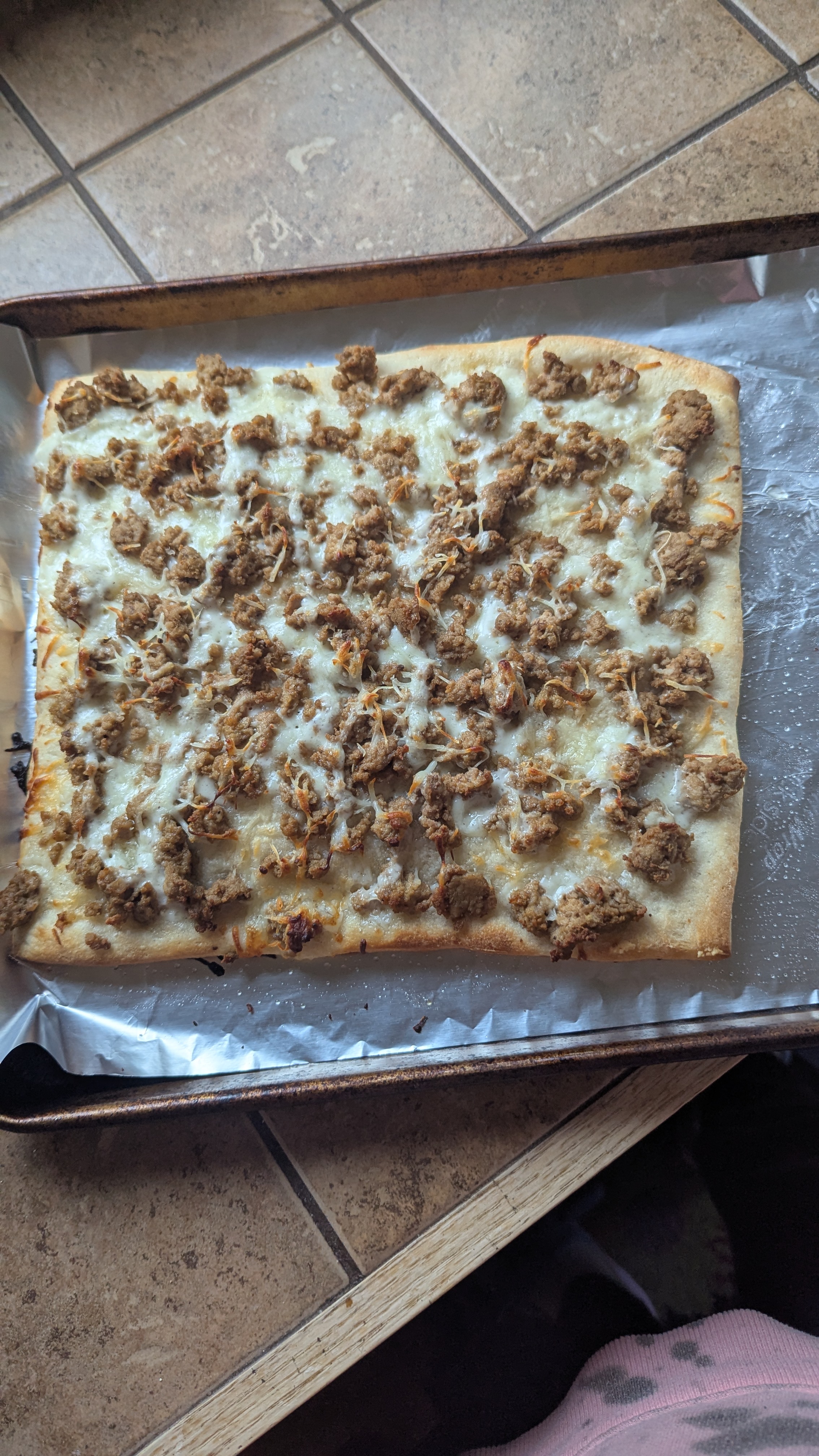
I regret adding a few more lines of ranch on top of the ground chicken layer on this one, it kind of worsens the appearance of the pizza.
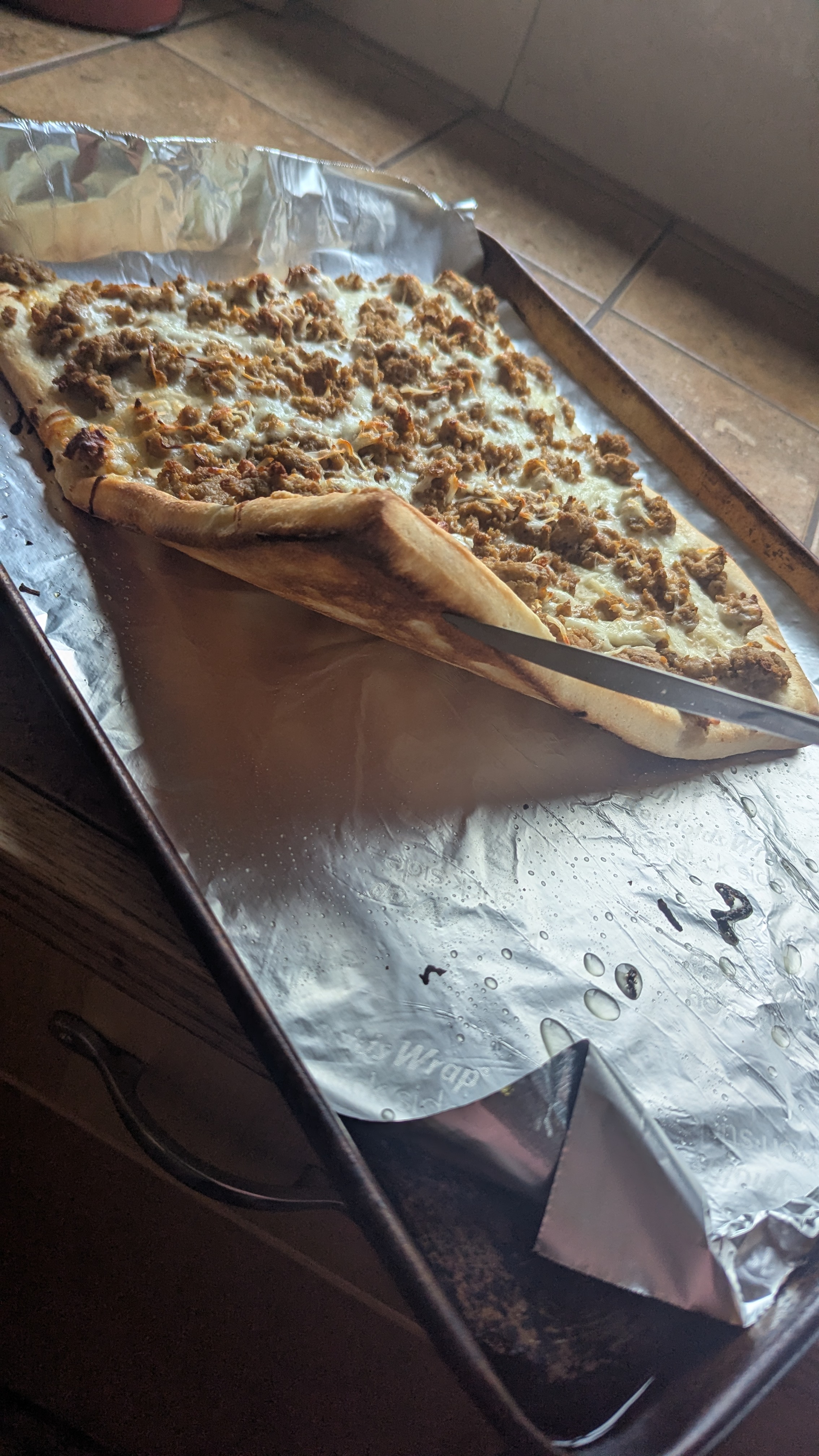
I liked it so much that I went to the grocery store, bought some bacon and another ready to bake dough, and made a chicken bacon ranch pizza with browned onions on the same day, which was even more delicious, more so due to the onions than the bacon.
The problem with cooking pizzas
The issue with making pizzas from scratch is with the availability of frozen pizzas like $4.52 rising dough Great Value pizzas and $6.82 Better Goods pizzas (my Walmart’s 2026 prices), I feel that my pizzas need to be very competitive with those in both flavor and cost. I can mentally sort of exclude the $1.96 cost of a frozen chub of ground chicken, since that is a lot of protein and I would eat it anyway with rice if I wasn’t topping a pizza with it. The bread flour that I purchased was $3.98 for a 2.26kg bag, so enough to making 8 pizza dough balls total, by making 2 dough balls from 500g of flour four times, and that allows a little extra flour to use when kneading the dough. Further science will be needed to calculate the pizza/cost of my pizzas vs the ready to cook pizzas here since there are different ways to use that amount of pizza dough to make pizzas with. If I make a marinara sauce from scratch, the 28 oz can of crushed tomatoes is $1.57, which may be enough for 2 pizzas from a 500 g flour recipe. An 8 oz bag of italian cheese blend is $1.97 and may be enough for 4 pizzas from 1000 g flour. Assuming 4 pizzas are made from 1000 g bread flour, one 7 g packet of active dry yeast, two 28 oz cans of crushed tomatoes, 2 onions, 10 cloves of garlic, and one 8 oz bag of italian cheese blend, the cost for 4 pizzas is $2 (1 kg bread flour * $3.98/2 kg bread flour) + $0.40 (3 packets 7 g yeast is $1.18) + 2 * $1.57 + $0.35 (onion and garlic cloves) + $1.97… That rounds up to $8 so $2 per pizza. Like I said, further science will be needed to calculate the pizza/cost. These pizzas made from about 250 g of flour are not as substantial in terms of size, number of calories as Great Value rising dough pizzas by my current intuition. Since frozen pizzas are so competitive in terms of cost, they give me a natural target to beat at flavor (Better Goods is pretty hard to beat in my opinion) and nutrition though I can always win nutritionally by topping the pizzas with entire pounds of ground chicken if I want. That chicken pizza recipe can be tweaked by varying seasonings, sauce used, onion vs no onion, if that does become the standard pizza I continue to cook.